Showing posts with label families. Show all posts

Tuesday, March 15, 2011

Dinner Talk


A few weekends ago, my dad took me out to dinner in Sacramento. Across the room I saw a couple that appeared to be on a Saturday night date but at some point I think they had forgotten about each other. In a span of forty five minutes, the couple had only one short verbal interaction. The rest of their time was spent with their Blackberrys positioned directly in front of them.

This was not the first time I had seen an interaction like this. Across the country families, friends, and dates alike suffer from phone obsessions at the dinner table. Even as my dad and I enjoyed our meal, we played with his iPhone as I showed him how to use new apps. Technology at the dinner table has become a true problem in society. Silence during dinner with friends is more common as they take a quick minute to reply to texts. The effort of a family dinner is in constant disruption when the kids are distracted by Facebook.

The problem has grown so large that Ingrid Zweifel has designed a “Phonekerchief.” This modified handkerchief has special metal threads weaved in to block out wireless connection and cell reception. The easy solution is to just turn your “Crackberry” or “iTeat” off but the idea of the Phonekerchief is the statement made when you place your phone inside. Soon, we may be seeing formal place settings with Phonkerchiefs included for everyone to see that your phone is off so that you are an active member of the dinner conversation.

This is just a small clever technique for a giant problem growing in our country. Most of my meals are spent conversing with my family and friends and I intend to keep them that way. I enjoy the time spent away from my computer and phone and I can only hope that my generation will eventually feel encouraged to disconnect as well.

Saturday, January 22, 2011

Warning: Disconnect!

My mother called on Thursday. Our AT&T bill had jumped up thirty dollars and she wanted to know what  I had been "up to." Like many young Americans, I live in an era of suspended adulthood--my parents still help to pay the bills for tuition, rent, and some living expenses. My fiscal contribution, negligible at best, is the spending money I attempt to save from my campus job.

Growing up, my parents taught me the importance of respecting boundaries as well as fiscal responsibility. That said, knowing I have a limited texting plan, I ought to have remained well within the limit, monitoring my use. I know better. But, I did not; I ended up texting nearly double my limit. Thirty dollars is a small fortune to my near-minimum-wage salary, but for my parents, it is earned easily.  However, I still feel terrible. Yes, my parents bought me a phone and pay for my phone bill, but how many of my minutes or texts were actually spent on them? These days I'm so busy and socially engaged that I'll call my parents at best, once a day, or, more often than less, receive their calls wondering about my health, safety, and school.

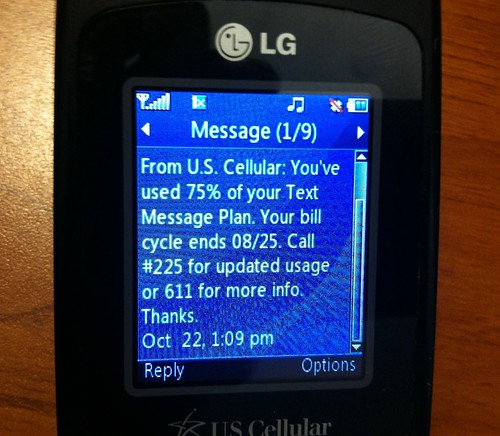
Cellphone Usage Alert
Therefore, when I heard about the FCC's proposition to instate mandatory alerts to cellphone overages, I was interested. What better way to monitor cellphone usage than mandatory alerts? As stated in the New York Times articles, users would receive notifications before they reach their plan limit, when they reach their limit, and right after they pass their limit. That way, one could adjust their usage accordingly and anticipate or limit their future use. Sounds great, right?

Well. Not to the phone companies.
The wireless industry’s trade group, C.T.I.A.-The Wireless Associationargues that the F.C.C.’s proposal “violates carriers’ First Amendment protections”; it contends that compelling carriers to provide use alerts is a form of “compelled speech.” So, by this logic, the carriers should be allowed to remain silent while your phone gobbles up data bits beyond your plan’s allocation.
The industry says customers can check their current charges by going to their carrier’s Web site and looking them up — or by sending short codes on their phones or installing apps on their smartphones that can provide a tally of minutes and data use. And if customers don’t remember to check, the carriers can shrug and say, “Not our fault.”
Just great. While I agree cellphone users should be responsible with their own usage, extra reminders to monitor usage would really boost responsibility. Mandatory alerts would serve as a wake-up call when you become too caught up texting or going online on your handheld device. It would prompt you to don that mantle of responsibility, helping you realize whether you should adjust your usage or invest in an alternative texting/data plan (i.e. unlimited data plans). But then, a sickening realization hit me. It would really hurt profits for phone companies if we were responsible about our consumption of social technology.


In class we've discussed benefits and the many detrimental side effects of being constantly connected, but the one aspect we seem to have overlooked, perhaps, because we do not pay the bills, is the fiscal side. We may feel "good" being connected, but somewhere out there are marketers, phone carriers, and internet providers urging us to fall deeper into the abyss of social technology. So, while the FCC and CTIA wrangle this proposal indefinitely, we should start working on responsibly consuming social technology. As for me, please don't text me until next month.

Thursday, January 20, 2011

No More Make-Believe: the Death of Healthy Childhoods


When I was a kid, all of my spare time was spent reading or playing. Winters were spent curled up in front of the fire reading every book I could get my hands on and summers were spent running around outside, practically naked, for every moment of daylight. Stories in my head came alive in make-believe games; everything I did came from my imagination and was brought to life with my bare hands and with whatever I could turn into toys or props to enact my stories. My friends and I made hundreds of miniature fairy villages out of stones, twigs, and leaves, dressed ourselves up as pirates, princes and princesses, and romped through the mud until we became brown mud-monsters that were not allowed anywhere near the white furniture. This was my entire childhood; there was no Internet, no television, and no constant input of media. I was always happy, energetic, and, albeit constantly muddy, healthy.

Now, I look at my ten-year-old sister and how she is growing up. She was introduced to the Internet and television when she was about seven years old. I watched her slowly become more and more addicted to online games, social gaming networks for kids, education software, and Disney TV shows on Youtube. It’s as if her entire daily focal point is on the computer in the living room. She tunes the entire world out for hours everyday and her eyes gloss over as her brain hooks into the world of cyberspace. Getting her to just look up and focus on us when we are talking to her is a struggle.

Instead of using and expanding her imagination by reading and playing, my sister spends the majority of her leisure time online. I worry that all of the media is adversely effecting her development. I am not sure to what extent the constant connection is affecting her neurological responses, but I do know that her personality and reactions to social situations are extremely different from my own personality and reactions when I was her age. She is extremely volatile; after being constantly stimulated by media all day, any extraneous stimulation or stress throws her into a completely over-stimulated state. Temper tantrums are frequent and her real-life friendships suffer as she spends less and less time playing in person with her friends; they all have their own online gaming accounts and choose to spend their time together via the computer.

My experience of endless outdoor playtime and make-believe seems to be a foreign concept to my sister’s generation. In the book After the death of Childhood; Growing up in the Age of Electronic Media, David Buckingham explores this idea of the misplacement or loss of healthy childhoods. He explores the argument that electronic media is causing the disappearance or “death” of the type of childhood I had. Buckingham also touches on the idea that there is an ever-growing gap between different generation’s relationships with media and technology. He points out that the lines of what defines "childhood" are getting progressively fuzzy as the constant influence of media catapults children into pre-mature adulthood. 

The thing that is the most disturbing to me is that the amount of time my sister spends online is below the average of all of her friends and other kids her age. Everywhere I look, kids are plugged into their iPads, cell phones, laptops, Wii video games, etc., instead of spending their time actively playing with real-life toys and friends. My question is that is the world of cyberspace forcing healthy, playful childhoods into the backseat, or even destroying them all together? Can children develop properly with the constant stimulation from all of the surrounding media? I worry for the repercussions of this on my sister’s generation. 

~Cherise Glodowski

Friday, January 14, 2011

Is Technology Connecting or Disconnecting Families?

During my winter break, my parents and I took a trip to Tuscon, Arizona to visit the rest of our family for the holidays. Over the duration of our stay, it became increasingly apparent to my brother and I that our mother was attached to her cell phone and computer. At one point there was a complete upheaval in our night because the internet stopped working on my mom's computer (then was finally resolved in a forty minute phone conversation with tech support). These events opened my eyes, realizing how technology has dramatically changed our family dynamics. Even my mother, who banned television during the week in our younger years, has now succumbed to technological addiction.

I am just as guilty of these abuses as well. Numerous family adventures and meals came to a halt when I received an important e-mail or urgent phone call from a friend. Each of our technological addictions have completely altered our family interactions; every evening before dinner we converse over the tops of our laptops and at the dinner table all jump at the sound of a text. In a recent phone conversation with my mother, we talked about comments I had made on Facebook, rather than the activities of the day ahead. On the other hand, so many family moments have been shared using picture texts and skype. Using technology in this way, I have been able to witness each milestone in my nephew's young life, while attending college full time 300 miles away. I have seen the benefits and the disadvantages of a technologically savvy family and am curious how electronics impacted other families like ours.

In an article the New York Times published in June 2010, Kord Campbell and his wife were interviewed about Mr. Campell’s addiction to electronics. Brenda Campbell stated, “It seems like he can no longer be fully in the moment” while discussing his struggles with data over stimulation. I can relate to this in my own family interactions. Car rides are no longer a time for discussing the day’s activities, but an opportunity to change your Facebook status and check e-mails. There have also been some great benefits that have come with our smartphones, making our family more connected. We were able to receive hour by hour updates of my nephew opening presents from Oregon. It was very exciting to feel a connection to our family so far away but there were times I felt the constant multimedia messages were taking attention away from quality time spent with those who were present. For these reasons I am torn about whether or not our family has truly benefited from being constantly connected.

-Annie Roach