Showing posts with label text messaging. Show all posts

Tuesday, March 1, 2011

Stay Alive. Don't Use A Smart Car and Drive

Almost everywhere that you go, you are likely to see a campaign sign or bumper sticker that says "Stay Alive. Don't Text and Drive." Even when I took my driver's permit test last summer, one of the questions on the test was whether texting while driving is safe. The obvious answer is "no," yet there are a lot of people on the road who don't quite understand this concept. While not texting during driving is an important message, it's interesting to think that texting may be more dangerous on the road than any other distraction...Or is it?

In a recent New York Times article, columnist Maureen Dowd discusses how automobiles are now "smart cars" that possess the capability to read your text messages to you, manage and play your iPod, adhere to your emotional needs (i.e. you're having a bad day, so your car will cheer you up through vibrating seats or heated steering wheel), and even manage your email for you. All of this while you're driving! Is this safe? Perhaps the larger question is whether or not it's rational to countenance any distraction whatsoever. What happened to simply listening to the radio or having a conversation with yourself as you drive? Do our lives really demand that we be constantly connected? If so, where do we draw the line?

No research is available at the present time to offer a reference to the affect that these smart cars are causing on drivers, but there are many potential dangers to such technology. Sue Cishke, a Ford executive, argues:

Given that Americans are addicted to Web access and tech toys...It will never work to simply ban them. So we’ve got to figure out how we make people safer, and the more people can just talk to their car like they’re talking to a passenger, the more useful it would be.

Perhaps Ms. Cishke has a point. Maybe the automobile industry should serve consumers who demand smart cars. Or maybe the automobile industry should serve consumers with the need for boundaries regarding automobiles and technology that provide constant connectivity. Ultimately, safety is important, and it's wonderful to have automobile technology with vehicles that strive to protect and serve the driver. Still, there comes a point when too many bells and whistles pose a threat to overall security because of the fact that these same bells and whistles provide the most dangerous thing on the road: distraction.

Monday, February 28, 2011

Nu Txt

The entire purpose of this blog - Constantly Connected - is to analyze what it means to be constantly connected. However, there is very little focus on the “language” of constant connection, if you will. Emoticons and shorthand text are becoming more and more prominent, especially among the younger generations. I cannot go onto Facebook and look at any of my younger friends’ posts without observing “u” instead of “you,” “r” for “are” or “our,” “2” for “two,” “to,” or “too,” and so many others. Often, it makes me cringe. “These people are butchering the English language that I know and love,” I think to myself, and I am certain that many share that view.

However, as a student-designer who works with text as well as imagery, I can understand the value of this shorthand as simply the next stage in the evolution of language. Emoticons, such as the smiley face depicted by a colon and a close-parenthesis or :), are the perfect example of this step. Just like the ancient Egyptians or Chinese cultures, which used pictographic images to symbolize “things,” emoticons are being used to symbolize emotions (see image). A well placed emoticon can perfectly supplement the meaning of a text or instant message.

Fun Fact: according to National Public Radio’s “Wait, wait… Don’t tell me,” President Abraham Lincoln is supposedly the first to have harnessed the power of emoticons, by making a ;) – or a “winky-face” – in his speech to signify a pause for laughs.

Once one gets past the traditions and stodginess of English as we know it, one can see the advantages of txt shorthand: it’s fast, readable, and efficient. Plus, it doesn’t rely too heavily on proper punctuation, grammar, or spelling, meaning that everyone can easily participate. And, really, what good is the internet if it’s not democratic?

Monday, January 31, 2011

Is the Use of Technology Compromising with People's Safety?


“Stop, look, and listen,” are the three safety words I grew up reciting mentally to myself before crossing the street. Today, with technology making its way into our daily lives, the word “listen” is slowly being forgotten as more and more people are using iPods to listen to music while crossing the street. As people are tuning out external sounds from cars, more people are getting involved in car accidents. According to the New York Times article, States’ Lawmakers Turn Attention to the Dangers of Distracted Pedestrians three people have been killed since September as a result of listening to music while crossing the street in New York.

A bill is pending in the New York legislature that wishes to ban the use of distracting electronic devices like iPods and cellular phones while crossing the street. There should not have to be a bill placed in action for people to learn how to be responsible and remember those three words we all learned when we were in kindergarten. “Stop, look, and listen” are three actions that should be common sense to people while crossing the street. If technology is going to distract a runner from “stopping, looking, and listening” before crossing the street, then the runner should be able to make that decision whether or not to use their electronic device. Technology should not be held responsible people's lack of common sense.

Saturday, January 22, 2011

Warning: Disconnect!

My mother called on Thursday. Our AT&T bill had jumped up thirty dollars and she wanted to know what  I had been "up to." Like many young Americans, I live in an era of suspended adulthood--my parents still help to pay the bills for tuition, rent, and some living expenses. My fiscal contribution, negligible at best, is the spending money I attempt to save from my campus job.

Growing up, my parents taught me the importance of respecting boundaries as well as fiscal responsibility. That said, knowing I have a limited texting plan, I ought to have remained well within the limit, monitoring my use. I know better. But, I did not; I ended up texting nearly double my limit. Thirty dollars is a small fortune to my near-minimum-wage salary, but for my parents, it is earned easily.  However, I still feel terrible. Yes, my parents bought me a phone and pay for my phone bill, but how many of my minutes or texts were actually spent on them? These days I'm so busy and socially engaged that I'll call my parents at best, once a day, or, more often than less, receive their calls wondering about my health, safety, and school.

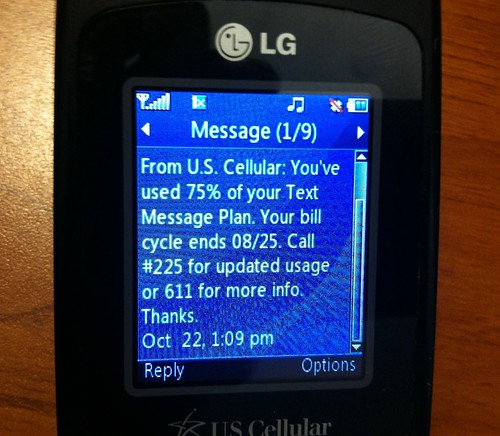
Cellphone Usage Alert
Therefore, when I heard about the FCC's proposition to instate mandatory alerts to cellphone overages, I was interested. What better way to monitor cellphone usage than mandatory alerts? As stated in the New York Times articles, users would receive notifications before they reach their plan limit, when they reach their limit, and right after they pass their limit. That way, one could adjust their usage accordingly and anticipate or limit their future use. Sounds great, right?

Well. Not to the phone companies.
The wireless industry’s trade group, C.T.I.A.-The Wireless Associationargues that the F.C.C.’s proposal “violates carriers’ First Amendment protections”; it contends that compelling carriers to provide use alerts is a form of “compelled speech.” So, by this logic, the carriers should be allowed to remain silent while your phone gobbles up data bits beyond your plan’s allocation.
The industry says customers can check their current charges by going to their carrier’s Web site and looking them up — or by sending short codes on their phones or installing apps on their smartphones that can provide a tally of minutes and data use. And if customers don’t remember to check, the carriers can shrug and say, “Not our fault.”
Just great. While I agree cellphone users should be responsible with their own usage, extra reminders to monitor usage would really boost responsibility. Mandatory alerts would serve as a wake-up call when you become too caught up texting or going online on your handheld device. It would prompt you to don that mantle of responsibility, helping you realize whether you should adjust your usage or invest in an alternative texting/data plan (i.e. unlimited data plans). But then, a sickening realization hit me. It would really hurt profits for phone companies if we were responsible about our consumption of social technology.


In class we've discussed benefits and the many detrimental side effects of being constantly connected, but the one aspect we seem to have overlooked, perhaps, because we do not pay the bills, is the fiscal side. We may feel "good" being connected, but somewhere out there are marketers, phone carriers, and internet providers urging us to fall deeper into the abyss of social technology. So, while the FCC and CTIA wrangle this proposal indefinitely, we should start working on responsibly consuming social technology. As for me, please don't text me until next month.

Wednesday, January 12, 2011

Is Text Messaging Preventing Intellectual Growth?


Everyday I take the bus to and from class, and everyday more than half the people on the bus are fiddling on their cell phones. I am one of the few who is just sitting on the bus staring out the window. It amazes me that so many people feel this constant pressure always to be connected to other people through text messaging. When I am on the bus, I am surrounded by vibrating cell phones with incoming text messages, which makes it impossible for me to form a single thought. With the average American teenager both sending and receiving 2,272 text messages a month in 2008 according to the Nielsen Company, it is impossible for teenagers to develop an imagination without allowing time to space out and let their minds wonder. When a teenager is given a chance to do nothing, it seems like the first thing they want to do is go on their cell phones and start engaging in a text message conversation instead of allowing time for their brain to process everything that has happened that day.

According to a New York Times article called Growing Up Digital, Wired for Distraction, researchers have found that the effects of technology are more powerful in teenagers than adults. For instance, teenagers’ brains are still developing and can more easily habituate to multitasking than adults’ brains. Technology makes teenagers less likely to be able to hold their attention on one thing. I think it is important to not get so consumed in technology and the need to always be connected to people. It is important to give yourself down time to form thoughts, opinions, or ideas in order to grow into an intellectual person.

-Christina Breitenbuecher

Sunday, January 2, 2011

Talk to the Handsfree


The photo above is a link to a recording of my senior project at UCLA, an interpretive dance about my addiction to my cell phone. The project was based on my senior thesis, titled "Talk To The Handsfree," and expanded upon the ways in which long distance relationships affect our short distance relationships with the people around us.

The first ten seconds of the video was a prank played on the audience. After the curtains opened and shortly before the lights went up, I asked all of the performers to whip out their cell phones to check the time or for text messages and missed calls. Sure enough, one of my professors who had sat in the house with the rest of the audience informed me later on that over half the audience had done the same thing and it took them a few moments to look up from their own phones to see that we were mocking them.

The first section of the performance was a joke about the awkwardness of being in such close proximity to other bodies (i.e. when we are in a crowded elevator). My theory was that we have grown quite bad at socializing with neighbors or making new friends quickly because cell phones and wi-fi allow us to take the comfort of our already-made-friends and family with us wherever we go; whereas before these techological developments, we may have been forced to form new relationships. But then again, perhaps I'm wrong, and we've always been awkward with face to face interactions.

The rest of the project comments on our relationships to and through our cell phones, automated voice messaging and automated responses (i.e. "lol" and "omg"), multi-tasking, being in multiple places at once, and so on. I like to leave room for interpretation of course.