Saturday, January 22, 2011

Warning: Disconnect!

My mother called on Thursday. Our AT&T bill had jumped up thirty dollars and she wanted to know what  I had been "up to." Like many young Americans, I live in an era of suspended adulthood--my parents still help to pay the bills for tuition, rent, and some living expenses. My fiscal contribution, negligible at best, is the spending money I attempt to save from my campus job.

Growing up, my parents taught me the importance of respecting boundaries as well as fiscal responsibility. That said, knowing I have a limited texting plan, I ought to have remained well within the limit, monitoring my use. I know better. But, I did not; I ended up texting nearly double my limit. Thirty dollars is a small fortune to my near-minimum-wage salary, but for my parents, it is earned easily.  However, I still feel terrible. Yes, my parents bought me a phone and pay for my phone bill, but how many of my minutes or texts were actually spent on them? These days I'm so busy and socially engaged that I'll call my parents at best, once a day, or, more often than less, receive their calls wondering about my health, safety, and school.
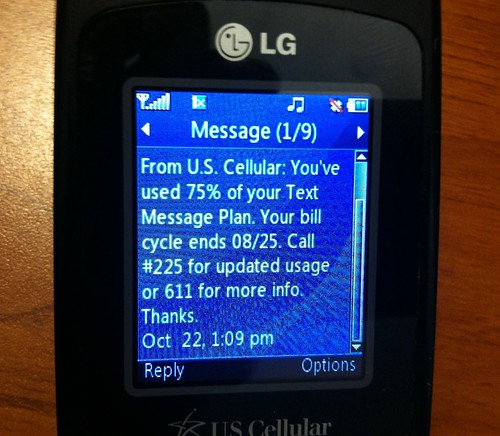
Cellphone Usage Alert
Therefore, when I heard about the FCC's proposition to instate mandatory alerts to cellphone overages, I was interested. What better way to monitor cellphone usage than mandatory alerts? As stated in the New York Times articles, users would receive notifications before they reach their plan limit, when they reach their limit, and right after they pass their limit. That way, one could adjust their usage accordingly and anticipate or limit their future use. Sounds great, right?

Well. Not to the phone companies.
The wireless industry’s trade group, C.T.I.A.-The Wireless Associationargues that the F.C.C.’s proposal “violates carriers’ First Amendment protections”; it contends that compelling carriers to provide use alerts is a form of “compelled speech.” So, by this logic, the carriers should be allowed to remain silent while your phone gobbles up data bits beyond your plan’s allocation.
The industry says customers can check their current charges by going to their carrier’s Web site and looking them up — or by sending short codes on their phones or installing apps on their smartphones that can provide a tally of minutes and data use. And if customers don’t remember to check, the carriers can shrug and say, “Not our fault.”
Just great. While I agree cellphone users should be responsible with their own usage, extra reminders to monitor usage would really boost responsibility. Mandatory alerts would serve as a wake-up call when you become too caught up texting or going online on your handheld device. It would prompt you to don that mantle of responsibility, helping you realize whether you should adjust your usage or invest in an alternative texting/data plan (i.e. unlimited data plans). But then, a sickening realization hit me. It would really hurt profits for phone companies if we were responsible about our consumption of social technology.


In class we've discussed benefits and the many detrimental side effects of being constantly connected, but the one aspect we seem to have overlooked, perhaps, because we do not pay the bills, is the fiscal side. We may feel "good" being connected, but somewhere out there are marketers, phone carriers, and internet providers urging us to fall deeper into the abyss of social technology. So, while the FCC and CTIA wrangle this proposal indefinitely, we should start working on responsibly consuming social technology. As for me, please don't text me until next month.

Thursday, January 20, 2011

No More Make-Believe: the Death of Healthy Childhoods


When I was a kid, all of my spare time was spent reading or playing. Winters were spent curled up in front of the fire reading every book I could get my hands on and summers were spent running around outside, practically naked, for every moment of daylight. Stories in my head came alive in make-believe games; everything I did came from my imagination and was brought to life with my bare hands and with whatever I could turn into toys or props to enact my stories. My friends and I made hundreds of miniature fairy villages out of stones, twigs, and leaves, dressed ourselves up as pirates, princes and princesses, and romped through the mud until we became brown mud-monsters that were not allowed anywhere near the white furniture. This was my entire childhood; there was no Internet, no television, and no constant input of media. I was always happy, energetic, and, albeit constantly muddy, healthy.

Now, I look at my ten-year-old sister and how she is growing up. She was introduced to the Internet and television when she was about seven years old. I watched her slowly become more and more addicted to online games, social gaming networks for kids, education software, and Disney TV shows on Youtube. It’s as if her entire daily focal point is on the computer in the living room. She tunes the entire world out for hours everyday and her eyes gloss over as her brain hooks into the world of cyberspace. Getting her to just look up and focus on us when we are talking to her is a struggle.

Instead of using and expanding her imagination by reading and playing, my sister spends the majority of her leisure time online. I worry that all of the media is adversely effecting her development. I am not sure to what extent the constant connection is affecting her neurological responses, but I do know that her personality and reactions to social situations are extremely different from my own personality and reactions when I was her age. She is extremely volatile; after being constantly stimulated by media all day, any extraneous stimulation or stress throws her into a completely over-stimulated state. Temper tantrums are frequent and her real-life friendships suffer as she spends less and less time playing in person with her friends; they all have their own online gaming accounts and choose to spend their time together via the computer.

My experience of endless outdoor playtime and make-believe seems to be a foreign concept to my sister’s generation. In the book After the death of Childhood; Growing up in the Age of Electronic Media, David Buckingham explores this idea of the misplacement or loss of healthy childhoods. He explores the argument that electronic media is causing the disappearance or “death” of the type of childhood I had. Buckingham also touches on the idea that there is an ever-growing gap between different generation’s relationships with media and technology. He points out that the lines of what defines "childhood" are getting progressively fuzzy as the constant influence of media catapults children into pre-mature adulthood. 

The thing that is the most disturbing to me is that the amount of time my sister spends online is below the average of all of her friends and other kids her age. Everywhere I look, kids are plugged into their iPads, cell phones, laptops, Wii video games, etc., instead of spending their time actively playing with real-life toys and friends. My question is that is the world of cyberspace forcing healthy, playful childhoods into the backseat, or even destroying them all together? Can children develop properly with the constant stimulation from all of the surrounding media? I worry for the repercussions of this on my sister’s generation. 

~Cherise Glodowski

The Costs We Can Agree On

The people who consider technology a bane can rattle off the evils of its use. One cost that we have overlooked so far, though, is perhaps that which is most universally applicable. This is a cost that everyone cares about – money.

Whether or not our electronic devices are bringing on the downfall of humanity and changing our lives, take a second to think about how your bank account would be different if you didn't NEED these gadgets. That new laptop you needed for school? With a student deal, it only cost $500! That new WoW expansion you're clamoring for will cost $40 in addition to that monthly subscription. Even without games, the ever-intriguing Kinect will burn through $150 of your savings. Americans spend around 9% of their income on electronics and appliances, and we can expect our devices that keep us connected are responsible for a large portion of this cost. Let's face it, our devices are invariably expensive.

How do we rationalize these superfluous expenses? Technology constantly improves and advances, and what was cutting edge one week is old news the next. This decreases its cost and makes us feel better about buying it. When I was in high school, I wanted an iPhone (shocking, I know). When Christmas rolled around and my 2-year contract was up, my parents put my request into perspective. They told me that I could have an iPhone... OR I could have the money an iPhone would cost them in one year in cold, hard cash. I chose to stick with a basic phone, and save the money. In June, Apple changed the plan options from only a $30 a month option to two levels of data plans, with the lower costing $15. This helped my parents justify the cost, and this time when Christmas rolled around, I finally received my shiny new iPhone 4. I certainly appreciate the fact that it's cheaper in the long haul, and my parents felt like they weren't being ripped off. I cant help but wonder though, if the iPhone had been released with this pricing scheme, would they have been so keen on committing to a $15 a month plan?

This is all fine and well, but not everyone wants to wait four years to buy an affordable, outdated DS. We see everyone around us using the cool new "device to have" and we want it too. It is through our addiction and level of desire that we are able to justify these expenses. Owning the latest and gratest gizmo satisfies the cravings we have to be that person. It's totally worth it, right?

Internet Success Stories

Today’s culture is very fickle towards internet use. Researchers often conduct studies on health problems, mental and psychological deficiencies, and other ailments caused by constant connection to the internet. Parents and adolescents alike debate the pros and cons of constant technology use. In the end, most seem to conclude that constant connectivity and the internet cause nothing but harm. No matter how much evidence can be stacked up against the internet, a few success stories can be found that reinforce internet-lovers’ convictions. This begs the question: “Do the positive attributes of the internet compensate for being constantly connected to it?” There really isn’t a solid answer; this is just a thought-provoking discussion on the matter.

Internet success stories are frequent and noteworthy, but few are as well-known as that of teen pop artist, Justin Bieber. He began as a normal kid in Canada, but when his mom posted videos of his music covers on YouTube for their friends and family to enjoy, he became a YouTube star. A man named Scooter Braun randomly found one of Bieber’s videos and was so enthralled he had to find him. Braun took Bieber to jump start his career with the popular pop artist Usher’s guidance, and now girls ranging from ages three to 73 are screaming his name. After various number one hits, platinum albums, awards, and more, it has been made apparent that Justin Bieber is quite the internet success story. You might say that Bieber wasn’t technically “constantly connected,” but having any sort of YouTube presence indicates that the internet plays a significant role in a person’s life. Certainly no one can argue that Bieber was harmed by an internet presence. Although not everyone becomes rich and famous from being constantly connected, and almost none to this degree, many find musical careers, entrepreneurial endeavors, and other avenues towards success in this manner.

Now we know that constant connectivity can make you rich and famous, but can it save a life? This success story certainly suggests so. Nancy Makin weighed in at a whopping 700 pounds for over 12 years, and her weight gain only promoted hopelessness. When her sister gave her a computer, Makin’s life began to improve. She stated, “The anonymity of the computer gave me access to a world that would have just as well have left me alone, alone to die but I did not.” Online, Makin made and maintained many friendships. In these online friendships, she wasn’t judged by her looks but by her personality. She found love and acceptance through her constant connectivity, and as a result, Makin lost weight. She didn’t use any sort of weight-loss techniques; she just stopped overeating. The depression was no longer an issue, and her psychological state vastly improved. Makin now weighs around 170 pounds, and she hopes that her story will inspire others to do the same. Did her constant connectivity directly save her life? Well, no, but as a result of spending her time immersed in the internet, her health and mental state improved tremendously, thus increasing her standard of living and presumably prolonging her life. A lot can be said about the possibility of constant connectivity helping to improve peoples’ lives in this manner.

You will probably maintain your beliefs as to the effects of constant connectivity, but hopefully after reading this and examining the success stories, you at least did a double-take. Constant connectivity and the internet may be plagued with negativity, and some of it may be true, but some good can also come of this constant connectivity. Many people base their livelihoods on the internet and their ability to remain constantly connected. It is arguable that constant connectivity in this manner benefits these people more than it harms them. If standard of living can increase for these internet users, who are we to tell them that what they do is a detriment to their health and well-being?

Photo Credit

Wednesday, January 19, 2011

Should e-mails and letters have the same legal protection?


What we post on the Internet can last forever. With easy, free access to sites such as Facebook, Twitter, Yahoo, and Myspace, it is now easier than ever before to share our thoughts, photos, and personal information online. But should whatever we post online be able to be used against us? On the one hand, we may post information with the intention of sharing aspects of our lives with our friends, but on the other, without proper privacy settings in place, anyone can access our information, including law enforcement.

This brings us to question: can what we post online be used against us in the court of law? The answer to that question right now is “no”. The Electronic Communications Privacy Act is responsible for governing the surveillance of what we do online. However, this act was written in 1986, long before the Facebook era, making many believe that this act is well outdated. The New York Times 2011 article Should E-mail and Letters Have Equal Legal Protection? addresses the issue of updating this act to make it more applicable to modern technology. In 2011, it is rare for communications to occur via snail mail; hence, a lot of relevant communication for legal cases may be stored online.

Updates have been made to the act such as a fraud case considered last month in the United States Court of Appeal for the Sixth Circuit. The judge ruled that law enforcement cannot access e-mail messages stored online without a warrant because the Fourth Amendment guards against unreasonable searches, which may now be extended online.

This article brings up the issue of the law lagging behind fast-changing technology. Laws take time to be passed and put in place. Technology is advancing so quickly, that it is hard for lawmakers to keep up. Recent laws associated with technology are coming into place such as the law regarding telephone usage while driving. This particular law is easy to enforce because officers can visually see drivers breaking the law. But what about incidents such as online predators? Enforcing laws against online predators is a much more difficult task because there are no online monitors. Steps towards having officers monitor online activity would be a great advancement in prevention of online illegal activity.

Constantly Connected, All Over the World

Not only are we constantly connected, but we’re widely connected. Not to hate on Lady Gaga, but her biggest contribution to my life was made possible through the very wide-spread use of technology and the internet.

This hilarious video highlights our ability to be constantly connected. (A parody of a song about being constantly connected, made possible by being constantly connected!) The men depicted are on active duty, stationed in Afganistan. This is perhaps one of the most inaccessible (to outside communication) positions on earth, and yet they are still in a position to watch music videos, video themselves, compile and edit the video, and distribute it! It is truly amazing!

I won’t say anything about the time this takes away from their other duties… Or maybe it’s great for morale? Whatever the case, these Army personnel are now able to be a part of mainstream society in a way that was completely unthinkable just a few short years ago. Now they’re stars, when in yesteryear, their only ways to reach the outside world would have been directly to a loved-one (letter, phone call), or as part of a propaganda/media initiative controlled by the “higher-ups” in the Army and politics.

These Army personnel now have almost as much societal freedom as you or I. Technology makes their lives more normal in an otherwise un-normal situation. I didn’t think of this until just now, but I wonder if this affects their adjustment in coming back home. Comments are welcome, and think of this: the more normal creepy is, the creepier normal is.

These Things Better be Durable


I still remember the words of caution from the AT&T salesperson upon my first iPhone purchase: "Be careful with these things, after using this you won’t be able to use any other phone." Considering how excited I was to finally have an iPhone I was quick to agree with him. But at the time I don’t think I realized exactly what his warning meant. My name is Yara Zokaie, and I am an iPhoneaholic. While I believe my iPhone has more benefits than detriments, I will also admit that my addiction is pathetic. No, that doesn’t mean I plan on cutting back. After all, the first step to recovery is admitting it, right? Well here's why I had to confess to an addiction, and how you can tell if you will soon be doing the same.

1) I use the internet on my iPhone.. while sitting in front of my laptop
2) I check my email on my computer about once a week. I check the e-mail on my iPhone.. as soon as it notifies me I have a new one. (roughly every 10 minutes)
3) I have about 30 "just in case I one day need them because who knows when you need to know who the 26th president is" apps.
4) I don't know my schedule. It's all in my calendar app.
5) I don’t own a camera.
6) I’m on Facebook all the time, but its not in my computer's internet history
7) I have my "to do" list, shopping list, notes to self, and online banking on my iPhone
8) Texting has become my preferred form of communication.
9) My phone is my alarm clock.
10) If my iPhone broke, I would spend a few days in bed eating ice cream and watching old movies.


If you're still wondering if iPhone addictions are real (after that list you're still wondering?), look no further than the Huffington Post. Only 6% of iPhone users claimed that they were not addicted, and 75% sleep with their phone next to them (guilty). My addiction was shoved in my face further when a simple glitch in my phone caused me to be late to work.. twice. An iPhone glitch on 1/1/11 caused iPhone alarms to stop working. Where was I during this crisis? Sleeping, along with the other 89% of iPhone users who don't own an alarm clock. One angry customer, Lindsay G, wrote to Steve Jobbs:
"Mr. Jobs, I’d like to let you know that you have officially, directly
contributed to unemployment in 2011. If you had warned me about the glitch,
I could have at least picked up a $5 battery operated alarm clock that would
have saved my job. Now I’m unemployed in a time when jobs are not easily
had, and I am short on my rent. So, Happy New Year to you, Mr. Jobs, I hope
you remember to shoot me an email next time there is any chance of a glitch."
It's not my character to blame my problems on someone else, but Lindsay does set a nice example.
Dear Apple,
Thanks for the iPhone addictions. It makes our lives so much more efficient, and that much more dependent.
PS: Why didn't you warn Lindsay of the glitch you didn't see coming?

Tuesday, January 18, 2011

A Virtual Reality

The BBC reported that in 2009, a South Korean couple returned home from a local internet cafe to find their infant daughter dead in her crib. The couple called the police and lied about their previous whereabouts, stating that they had found their daughter after waking up in the morning. The case was placed under investigation and a later autopsy determined that the infant had starved to death after suffering from long term malnutrition. Further investigation found that this couple had constantly left their daughter home alone, only to return once a day to give the child a single bottle of milk. The couple was arrested in March of 2010.

Authorities later found that the couple spent both day and night at a local internet cafĂ©, raising a virtual daughter instead of their own. In essence, this couple was constantly connected to their video game. They had become so immersed in this game that they ignored anything unrelated to it. This couple was playing a massive multiplayer online role playing game, or MMORPG. An MMORPG is a genre of computer role-playing games in which a very large number of players interact with one another within a virtual game world. This genre includes games such as World of Warcraft, Final Fantasy and Prius Online. Such games allow players to customize their character’s appearance, actions and behaviors. These players are then immersed into a unique virtual world and are allowed to grow as a character and form relationships with other players. To many, these games offer an opportunity to reinvent oneself in a virtual world and can become very addicting.

One might ask how a video game can become addicting enough to inadvertently kill one’s own child? Police officer Chung Jin-won told reporters that the Korean couple "lost their will to live a normal life" after losing their jobs. Prius Online gave them the opportunity to escape to a new world, one which they could easily control and live happily; however, the couple became lost in the game and forgot about their daughter and their lives at home.

The incident in South Korea certainly demonstrates the destructive nature of video games and their addictiveness. I, however, am one of the 15 million people who play these games each year and I, like most individuals, am able to lead a normal, healthy life. I believe that MMORPGs, like any activity, have various positive qualities when taken in moderation. They provide many new opportunities to video gamers and offer new ways to form friendships over long distances. Such video games have also been found to relieve stress and foster prosocial behaviors. These positive qualities may cause the addicting nature of MMORPGs; however, it is rare that events like those in South Korea that should serve as a warning to the potential danger of being constantly connected.


Monday, January 17, 2011

My Cat is Better Than Yours


iPhone applications (commonly known as apps) have come a long way since when they first debuted as primarily a tool for the investor and entrepreneur. However, with an ever active community of hackers and developers, the app library of the iPhone and iPad now has some off the most addictive games ever created (admit it, you’ve all spent hours playing those games). Soon, people started making games not for the iPhone owner, but rather their children. Disney games soon started to populate people’s devices, and children soon started to want their parent’s iPods to play those games. Now who would have thought that the next natural step would have been to create games for one’s pets, specifically cats! Well according to developer Nate Murray (developer of the now popular Game for Cats), it is indeed the future.

The idea of the games are simple, entertain your pet with your electronic devices. Apps such as Game for Cats, App for Cats, or Cat Toy are all currently on iTunes available for download. Conceptually, all of these games are the same, some kind of sprite moving around a screen. What’s interesting is how successful these apps seem to be. If you had told me even 5 years ago that one day this would be the future even I would have been skeptical. 5 years ago I would have never guessed that our society would become that dependent on their electronic devices to even rely as forms of entertainment for our pets.

However, watching this shift in culture has been interesting. I wonder if in the future when holograms become all the rage, will they be an acceptable form of entertainment, for both people and pets? Will one day people give up actual adventures into the woods to be replaced by journeys to places recreated purely by technology? Does this represent a fundamental shift in how people are now going to spend their time, forever getting more and more addicted to their portable electronic devices?

Photo Credits: http://www.thevine.com.au/resources/imgthumb/cat-ipad-fun-thumb_190410103144.jpg

 -Peter Yao

Friday, January 14, 2011

Is Technology Connecting or Disconnecting Families?

During my winter break, my parents and I took a trip to Tuscon, Arizona to visit the rest of our family for the holidays. Over the duration of our stay, it became increasingly apparent to my brother and I that our mother was attached to her cell phone and computer. At one point there was a complete upheaval in our night because the internet stopped working on my mom's computer (then was finally resolved in a forty minute phone conversation with tech support). These events opened my eyes, realizing how technology has dramatically changed our family dynamics. Even my mother, who banned television during the week in our younger years, has now succumbed to technological addiction.

I am just as guilty of these abuses as well. Numerous family adventures and meals came to a halt when I received an important e-mail or urgent phone call from a friend. Each of our technological addictions have completely altered our family interactions; every evening before dinner we converse over the tops of our laptops and at the dinner table all jump at the sound of a text. In a recent phone conversation with my mother, we talked about comments I had made on Facebook, rather than the activities of the day ahead. On the other hand, so many family moments have been shared using picture texts and skype. Using technology in this way, I have been able to witness each milestone in my nephew's young life, while attending college full time 300 miles away. I have seen the benefits and the disadvantages of a technologically savvy family and am curious how electronics impacted other families like ours.

In an article the New York Times published in June 2010, Kord Campbell and his wife were interviewed about Mr. Campell’s addiction to electronics. Brenda Campbell stated, “It seems like he can no longer be fully in the moment” while discussing his struggles with data over stimulation. I can relate to this in my own family interactions. Car rides are no longer a time for discussing the day’s activities, but an opportunity to change your Facebook status and check e-mails. There have also been some great benefits that have come with our smartphones, making our family more connected. We were able to receive hour by hour updates of my nephew opening presents from Oregon. It was very exciting to feel a connection to our family so far away but there were times I felt the constant multimedia messages were taking attention away from quality time spent with those who were present. For these reasons I am torn about whether or not our family has truly benefited from being constantly connected.

-Annie Roach